


 Cart
Cart
 sales@molnova.com


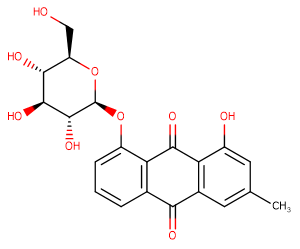
Chrysophanol 8-O-glucoside
CAS No. 13241-28-6
Chrysophanol 8-O-glucoside ( —— )
Catalog No. M21700 CAS No. 13241-28-6
Chrysophanol 8-O-glucoside and chrysophanol have mild cytotoxicity and anti-diabetic properties and can play metabolic roles in the insulin-stimulated glucose transport pathway.
Purity : >98% (HPLC)
 COA
Datasheet
HNMR
HPLC
MSDS
Handing Instructions
COA
Datasheet
HNMR
HPLC
MSDS
Handing Instructions
| Size | Price / USD | Stock | Quantity |
| 5MG | 210 | Get Quote |


|
| 10MG | 335 | Get Quote |
|
| 25MG | 554 | Get Quote |
|
| 50MG | 782 | Get Quote |
|
| 100MG | 1053 | Get Quote |
|
| 200MG | Get Quote | Get Quote |
|
| 500MG | Get Quote | Get Quote |
|
| 1G | Get Quote | Get Quote |
|
Biological Information
-
Product NameChrysophanol 8-O-glucoside
-
NoteResearch use only, not for human use.
-
Brief DescriptionChrysophanol 8-O-glucoside and chrysophanol have mild cytotoxicity and anti-diabetic properties and can play metabolic roles in the insulin-stimulated glucose transport pathway.
-
DescriptionChrysophanol 8-O-glucoside and chrysophanol have mild cytotoxicity and anti-diabetic properties and can play metabolic roles in the insulin-stimulated glucose transport pathway.
-
In Vitro——
-
In Vivo——
-
Synonyms——
-
PathwayOthers
-
TargetOther Targets
-
RecptorOthers
-
Research Area——
-
Indication——
Chemical Information
-
CAS Number13241-28-6
-
Formula Weight416.4
-
Molecular FormulaC21H20O9
-
Purity>98% (HPLC)
-
SolubilityIn Vitro:?DMSO : 50 mg/mL (120.08 mM)
-
SMILESCC1=CC2=C(C(=C1)O)C(=O)C3=C(C2=O)C=CC=C3O[C@H]4[C@@H]([C@H]([C@@H]([C@H](O4)CO)O)O)O
-
Chemical Name——
Shipping & Storage Information
-
Storage(-20℃)
-
ShippingWith Ice Pack
-
Stability≥ 2 years
Reference
1.Qi F Wang Z Cai P et al. Traditional Chinese medicine and related active compounds: A review of their role on hepatitis B virus infection[J]. Drug Discoveries & Therapeutics 2013 7(6):212.
molnova catalog



related products
-
Benzoylgomisin H
Benzoylgomisin H is a natural product from Schizandra chinensis.
-
p-Valerylphenol
p-Valerylphenol can be used to synthesize acylphenoxyacetic acid compounds.
-
Catalase
Catalase is an essential enzyme in the metabolism of H2O2 and reactive oxygen species (ROS).
